Tuesday, June 23, 2009
Bolivia Photo Night
Tuesday, May 5, 2009
Spider Killer - Bolivian Super Hero
Sunday
Saturday, May 2, 2009
The Seedier Side of Bolivia
Friday, April 24, 2009
The Final Shave
The final page has been turned on the Shave to Save saga. A good time was had by all (with the possible exception of Brent). Jack, just trying to be helpful, I'm sure, brought the hedge trimming shears, but Bob the Barber couldn’t hold them high enough long enough to get the job done, so the sheep shears had to come out.
When the tally was done there was $1,025.34 on my head. Not too shabby, I thought. The amount that is; my head was plenty shabby! I was a little concerned when Lyle pulled out a brown envelope, but, although it made the competition closer, it was not enough to claim all my hair! I managed to get $1,378.00 on Brent’s head, so he lost it all, so to speak! That makes a total of $2,403.34 going to Bolivia for various projects! Thank you, Thank you, Thank you! Tuesday, April 21, 2009
Sign Your Donor Card
I was involved in transplant surgery this past weekend, a surgery led by Dr. Joe. This is the second transplant surgery I have been involved with but the first time I’ve dealt with a scenario where there has been one donor and many recipients. I have mixed feelings now, after the procedure: sadness for the donor but happiness for all of those who benefitted.Part of my role on the transplant team was to escort the donor to the procedure on that fateful Good Friday morning. (Well, it was a “good” Friday for some; not the donor!) It was eerie knowing that I was the last to have a conversation with the donor before Dr. Joe began. I found it odd that the donor willingly proceeded to the site of termination. I questioned the ethics of assisting in the act that would end a life even though I knew that the death would save many. I could intervene and save the donors life, but at what cost? Is terminal really terminal? What if a treatment was found and the effects of time could be reversed? Would the death of one on Good Friday really save the lives of others? If so, how many would benefit? Could such matters be reduced it a “score card” type of evaluation?
With the donor immobilized and then terminated, Dr. Joe began to remove the heart. I had the honour of helping by removing many other vital organs. Even some cosmetic donations were made. It took only a few hours to take the donor from fully functioning, albeit worn out, to a stripped-out shell. This was the saddest part for me. I hate to think that we are only a few boxes of good parts in an aging, decaying case.
But with death comes life! A younger recipient with a bad heart now has a new heart, (new to them at least) and the opportunity to live again after years of convalescing. To see her come to life again, reborn , and leave the surgery under her own power was very rewarding. But the death of one on Good Friday meant life for not just one but many by Sunday. A new heart for one, yes, but a new front end for another and a new brain for a third and boxes of hope for many more yet to be touched by Friday’s Sacrifice.

Thanks to Dr. Joe for giving life to our newest and best-looking shiny blue firefly, for fortifying the front end on my dear old friend and driving partner (515,000 km and still going), and for adding a new CPU to Heather’s pride and joy. My shelf of pretty-good parts is also growing, and has inspired me to begin planning a little cosmetic surgery on my old girl.
Sign your donor card, and you, too, can bring life where only death looks likely. Remember those who have made sacrifices for us, and always be nice to your mechanic!Thursday, April 9, 2009
Shave to Save Update
Whoever “wins” 1st place (raises the most money) gets their head shaved clean!
Whoever comes in 2nd gets to keep a 1/2” of hair.
To donate:
- Email ggilchrist@oldscollege.ca, indicating amount of donation and who you are sponsoring.
- Or go to http://www.a-better-world.ca/ and click ‘donate online’ (Specify “Shave to Save” and either “Gord” or “Brent”)
(Charitable receipts available for donations of $25 or more. Include mailing address, please.)
If you want an idea of the kind of work these donations will support, read:
It is Not All Laughing Children and Happy Endings
How Does Your Garden Grow?
You Can’t Get There From Here
Bolivia or Bust Tour 2009!
Bolivia or Bust
How I Spent My Summer Holidays
Thursday, March 12, 2009
Back to the Basics of Lift


I pulled one of those many boxes off the shelf this week, and I have been amazed at how it has come to consume my train of thought again. The box was labeled “PRS” for Portable Remote Sensing. To be honest, PRS has never been fully shelved; it has been lingering in my grey matter since Murray and I started the project. With the Bolivia group going to map CERENID next month and an old friend, Dawn, working to create an information database for project sites, the need for good remote sensing data increases. My mind has shifted back to airfoils, amps, thrust, and lift.

I feel like my mind is reloading memory slots at the front of my brain with information I had pushed to the back. I have started sketching and drawing, thinking and evaluating. I stare off into space and recall what I have done, then start inserting new information gathered since the last time I did this. New camera information, new GPS equipment, better servos, smaller gyros and so on. I revisit old locations for inspiration and new ideas. I spent time inside my plane room--standing, thinking, experiencing new thoughts and feelings. I tried, somewhat successfully, to penetrate to the heart of the issue, savor the moment and energize my mind. Time well spent!

That night, only a few hours after new possibilities opened to me there in my plane room, a new drawing file appeared on my computer. It will morph over the next few weeks, and then the dust will start to fly. Years of diverse experience and fresh new ideas will combine to produce one black box. The contents of this box will have roots in the basics of lift, the fundamentals of aerodynamics.
I love to look ahead, but I have learned that you must never forget to look back first. There are physical laws that govern our universe, and there are past experiences that govern our perspective. With the exception of the bumble bee, things don’t fly that don’t conform to applicable physical laws; our new experiences, too, are more likely to ‘fly’ if we reflect on what we, and others, have learned before us. Friday, March 6, 2009
Form Challenged

Those who know me well will know that I am form challenged. I am not referring to poor body image; I mean that when I have to fill out a form, I freeze up. I once heard a comedian talking about childbirth who said that, when her baby was born, half her brain came out with the placenta and the other half slowly leaked out every time she breast fed. That is sort of how I feel when confronted by a form; half my brain leaks out my ears!

I am very careful with my passport when I travel; it is strapped to my body under all my clothes at all times. I do this for two reasons: first, if it is attached to me, I cannot lose it, have it fall out of a pocket, leave it in a bag on a bus or set it down and forget to pick it up; second, it is my hope that, if I am robbed, the robber will see the environment my passport has been in (fat, hairy, sweaty waist/groin region) and be so disgusted that they won’t want it. I hope I never have to put the second half of my theory to the test!

When I am home, I am not so careful with the passport, unfortunately. After my last trip, I accidentally washed my passport when I did my laundry--turning it into a 'coming home' passport (so called because, if I'd done this in Bolivia, I think I could have ironed it enough to get me back home). But it was not a 'going away' passport anymore, so I needed to replace it.
Enter “The Form.” With the passport form filled out and all the ID I think I need, I steeled myself for the dreaded trip to the passport office. It is not so much the waiting I dread, though there is sure to be plenty; it is the forgetting to fill in one line, having the picture somehow not being right, or running into any one of a hundred imagined circumstances that scares me. Filling in a new form on the spot would certainly have my brain leaking out and the rest of me hoping I retained enough grey matter to speak and walk.

We (my wife and I; she is my first line of defense against forms) entered the office and were greeted by the always-present white-haired commissionaire who was not surly or authoritative but pleasant and respectful. He politely asked us to turn off our cell phones and held the door as we entered. Next was the form-tearer/ID-checker. She, too, was very pleasant and efficient, sorting through the assorted documents, photos and ID, and neatly clipping the appropriate documents together. She handed back my documents with a number tag and suggested what wait time we might expect.

Eventurally, my number was called and up to gate 5 I went. I was greeted by a very pleasant and professional young lady who started processing my form. Everything was going swimmingly: all the boxes seemed to be filled out correctly, the ID seemed adequate and I briefly had a sense of hope. When I showed her my washed passport, she asked if I had filled out a lost or damaged passport form. My heart sank! She assured me that it was going to be OK. She gave me the form to fill out and explained that it had to be notarized. Seeing the look of terror on my face, she gently wiped the dribbling brain matter from my shoulders and handed me a sheet with addresses for nearby notaries. She gave me driving directions, her business card, and said that upon my return, I would not need to get in line again but that the commissionaire would direct me straight to her gate.
She was right! The copy house containing the notary was right were she said it would be. He was very pleasant, very welcoming and very understanding about my extra washing. He professionally did his duty and sent me on my way. When I got back to the passport office, the commissionaire held the door and directed me to gate 5--no waiting. My additional form was pleasantly accepted, and all is well...I think.
I want to thank all of you who dealt with me that day. Your cheerful manner went a long way to relieving my stress. If only I could have avoided driving diagonally across the entire city during rush hour! I will see you all in two years when I get to renew my passport; I promise I won’t wash this one.
Wednesday, February 25, 2009
It's NOT About Turtles

I’ll leave all the salmonella discussion alone because I am definitely not qualified to comment on national health policy. I will, however, comment on the appeal of the little red-eared slider turtle. I had more than one when I was growing up. I was a proud owner of them right up to the time they were banned, I suspect. I remember going to Super S Drugs in Calgary, going down into the basement and making a beeline for the pet section. I loved to look at the turtles, but I spent just as much time looking at the turtle bowls. Eventually, my parents caved, and it was a proud moment for me when I installed the little palm tree on the island in the center of the bowl and put Flash in his new home. Okay, to be honest, I don’t remember putting Flash in the bowl. But I do remember erecting that tree!

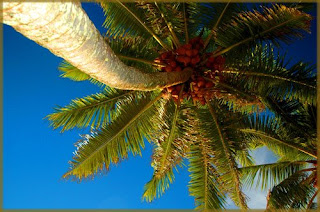
I don’t think Flash (sarcasm, irony and puns were three of the main communication tools in our house) ever took as much pleasure in the palm tree as I did. I loved the little brown trunk and the green pop-off fronds. It did not seem odd to me to be attracted to a tree at age 7, but, 30some years later, I have paused to give this a second thought. It seems to me that the little tree stood for something exotic and foreign, something I would never get to touch or see in person. (A trip to Vernon was a big deal at that time in my life.) Now, much later in life, it turns out that the tree was the easy part. I have touched, climbed, and lived off the meat of the coconut palm tree, but can’t seem to get my hands on a turtle!

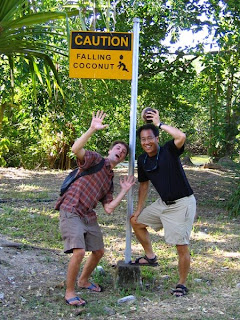
There is no question in my mind that the little tree in my turtle bowl sparked my imagination and motivated me to travel to faraway lands where I could sleep under the big brother to my bowl ornament. By the way, don’t sleep under a coconut tree; there are more people killed by falling coconuts than by sharks. As an aside, there is an entire industry based on climbing coconut palms and removing young coconuts before they mature and fall killing unsuspecting tourists. Take your inspiration where you find it, a plastic tree, a paper airplane, or even a falling apple (oh right, that one has been done).

Friday, February 20, 2009
Go Fast and Turn Left
I have been flying model airplanes of some sort for 40 years (I started very young!) and radio controlled airplanes for 32 years. For 30 years, I have been trying to go fast and turn left—the motto of a pylon racer. I have raced just about anything that flies—from gas airplanes that go faster than 200 mph to the very slow, electric Vapor racing. What would make a man do such a thing? I had to have a serious talk with myself early this Monday morning. I drove two hours to fly in a gym and race Vapors. This is a plane whose claim to fame is that it flies at the speed of an out-of-shape geriatric with a bad hip! At full speed I can keep up to this plane without breaking a sweat. So what is the appeal in racing these aircraft?
I have identified three types of racers over the years. There is the Tinkerer who loves to try new equipment, new designs, new props or new motors. I started out as this guy - always designing a new plane, always stretching the rules. There was lots of room to improve back then: the rules were loose, designs were evolving, and materials for construction were pretty standard. I had some successes as a Tinkerer. Paul, an engine wizard, and I teamed up to build the Ultrax. This plane was hands down the fastest thing in the sky, albeit a bit hard to control.

The Spender has made a bold appearance in the sport in recent years. This is the guy who simply buys the best of everything currently produced in the world. With the internet and international competition, anyone with enough money can fill these shoes. This approach does not guarantee success. I have seen many a Spender re-kit (crash) their high priced stuff due to a lack of skill. A significant number of these competitors seem to be divorced. Go figure!

It is the presence of the third group of racers (my current home) that makes Vapor racing possible. The Flyer wants to race evenly matched equipment. Ideally, all planes are exactly the same—that way, when I beat you, it is because I am a better pilot. This group would race dust bunnies if we could figure out how to put a radio into them. It does not matter how fast the planes go, as long as everyone is going about the same speed, and it is best if the race is very close. I would far rather place second in a very close race than win a race by three laps. It is the heat of battle that is the thrill, even more so than the victory. Don’t get me wrong; this is a very competitive group of people, but the pleasure comes from the race, not the win. There is more honour in a victory based on skill than a victory based on weaponry. 
I have wondered if this attitude has permeated past my flying and into my life. Those who know me will say, “YES!” I find that often my goal is to do more with what I have instead of having more: My car was the cheapest new car on the market when I bought it 18 years ago, and it currently has 510,000 km; I love to find free software to do the job of expensive, flashy software; I take great pleasure in getting water out of the ground cheaper and more reliably than the big NGOs. I don’t need to lead the race. I just want to win it in the last lap.

Friday, February 6, 2009
How Does Your Garden Grow?

A new member has been added to this May’s Bolivia trip. Wilma is going to join us and will bring her fruit tree and production garden experience with her. The goal for our group is to develop a three-year plan for food production for CERENID, a home for street boys, near Samaipata so her skills will valuable indeed. Also in the group we have Brent, an Olds College GIS student who will be in charge of mapping; Stacey, an Olds College Agricultural Production student, in charge of infrastructure; vets; a medical professional; a livestock specialist; an agricultural mechanic; and a writer extraordinaire! What a great team! Oh yes, and then there is me—the Jack of all trades.

Currently, the students are busily preparing their presentations with background information of Bolivia. We will have two presentations at noon on Friday March 13th.I am curious to see how their impressions of the country change as they go from impartial researching to actually travelling in and experiencing the country, because I’m very sure they will. For me, one of the best parts about traveling is that what I expect and what I end up experiencing is rarely the same thing. I suppose this also a good thing for the travel industry; if you could get the whole experience by merely researching a country, there would be far less incentive to spend all those wasted hours in airports!
The daily planner I use for these trips is a spreadsheet. That is because the plan changes often, and the idea of typing up a new one every time a change is made terrifies me! As I suspected would be the case, I am on version six of the schedule already—what with trying to coordinate in-country hosts and finally getting flights confirmed and such. I love spread sheets! I am moving, rearranging, and calculating like mad. It is the closest I get to being organized. (Thanks, Murray).

We have a great team assembled! Couple this with some great in-country contacts (you have to have great people on the ground) and I think we are looking at an unforgettable learning experience for everyone. It’s Bolivia or bust, baby. Just try to stop us now!
Wednesday, January 28, 2009
Jack of All Trades

I received an email a few weeks back that contained the following statement:
“None of us is master of all. (Jerk of all trades, master of none is NOT a compliment!)”
To put the statement into context, it was part of a plea to become part of a development team.
My first reaction was to wonder if I was supposed to be insulted by this statement. I was not insulted, first because the statement is false and second because I reasoned that the writer had not intended to insult because what would be the point in insulting those you were trying to get to volunteer? I have been called a Jack of all trades on many occasions, and I certainly think of myself in those terms. I have always said that, more often than not, it is the breadth of my knowledge, not the depth, that serves me best.

All of this got me thinking about why I believed that emailed statement to be wrong. After all, there is no sense in me saying, “You are wrong” if I can’t defend that position. I could quote other people to support my position. One of my favorite quotes comes from Adam Savage of the TV show Mythbusters who claims that the full quote actually is, “Jack of all trades, master of none, though often better than a master of one.” (http://www.youtube.com/watch?v=Z3Viv88ZOFA ) But is quoting really the way I should go here? I mean, you can always find someone to agree with you if you look hard enough, but that doesn’t mean you’re right.

Perhaps a more scientific basis for my defense would be useful. When it comes to building teams, observation of Mother Nature could provide inspiration and direction. Mother Nature abhors a vacuum and isn’t that pleased about a monoculture either. It has been my experience that similar rules apply to good teams. Working in a vacuum rarely gets the best results, and working only with likeminded people may be comfortable but tends not to maximize results. Now, that is not to say that you could randomly throw together anybody and expect great results, either. Try planting bananas and arctic lichen in the same field and see how productive you are.

So why is there value in being a Jack of all trades? I have foundational knowledge in many subjects but no towering structure on any one part of that foundation. But I’m okay with that. After all, if you put a bunch of experts on a team, it can often be difficult to transfer knowledge from one discipline to another. To get a letter from the top of one skyscraper to another, someone needs to carry that letter across a common foundation to get to the next building. A Jack of all trades knows enough to understand at a basic level and can relate that basic knowledge from one subject area to another area of expertise. Jack is the glue that holds the tiles of a mosaic together. Jack is the gravy in a stew… Well, you get the point.

I was listening to a physicist on CBC Radio the other day who said that Barack needs to take a course in basic physics. The interviewer asked why the president would need that knowledge considering that he has a stable full of experts. And, the interviewer asked, would a physicist make a better president? The response was a resounding NO. The president did not need to be a physicist but did need to understand the science behind global warming, green power etc. The president, in essence, needs to be so much more than a physicist; he needs to be a generalist. I would like to suggest that a generalist and a Jack of all trades are not that different.
You need Jack on your team to apply the information from one expert to help solve the problems in the seemingly unrelated field of another expert. Jack is the translator between experts. I am proud to be Jack, and I think every team needs one (but perhaps just one). I do take that designation as a compliment, not an insult. Embrace the Jack in yourself and wear the label proudly.